
Taking your parents for Umrah is one of the most meaningful trips a family can make together, and taking your children is a memory most parents hope will stay with them for life. It is also, honestly, a more demanding trip to plan than a standard Umrah for healthy adults travelling alone. Heat, crowds, long walking distances, and unfamiliar food all hit differently depending on age, and a little extra planning goes a long way toward making the trip comfortable rather than exhausting for the people you are travelling with.
Umrah With Elderly Parents
Mobility is usually the first thing to plan around honestly. Distances inside Masjid al Haram and between your hotel and the mosque can be considerable, and the marble flooring gets genuinely hot underfoot during the day. If a parent has any difficulty walking long distances, wheelchair assistance is available at the mosque, and it is worth arranging this in advance through your package rather than assuming you can sort it out on arrival during a busy period.
Choosing accommodation within easy walking distance of Masjid al Haram, or at minimum with reliable and frequent shuttle access, matters far more for elderly travelers than for younger ones. It is one of the reasons we tend to prioritize hotel proximity when building Umrah packages for families travelling with older parents, since even a ten minute walk in the heat can be genuinely difficult for someone with joint pain or limited stamina.
Health preparation deserves real attention too. Bring a full supply of any regular medication in original packaging, well beyond what the trip length technically requires, along with a written note in English of any medical conditions, current medications, and your parent’s doctor’s contact details. Saudi health authorities require meningococcal meningitis vaccination for all pilgrims, and it is worth checking with your parent’s doctor whether any other vaccines or precautions are advisable given their specific health history, particularly around heat tolerance and hydration.
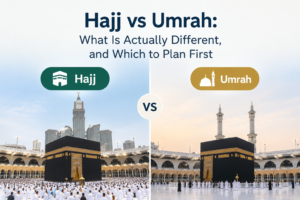
Umrah itself, being shorter and without Hajj’s most physically demanding days at Mina and Arafah, is generally more manageable for elderly pilgrims than Hajj is. Our comparison of Hajj and Umrah goes into why that distinction matters if your parents are also considering Hajj at some point, since the physical demands genuinely differ between the two.
Umrah With Young Children
There is no religious requirement to bring young children on Umrah, and for very young children, particularly infants and toddlers, many families choose to wait until the child is a little older simply for practical reasons around heat tolerance, crowd safety, and the length of time spent standing during Tawaf and Sa’i. If you do decide to travel with young children, a few adjustments make a real difference.
Keep a close, deliberate plan for staying together during Tawaf specifically, since the crowd density around the Kaaba can be intense at almost any hour, and it is remarkably easy to become separated even for a few seconds in a crowd that size. Some families choose to perform Tawaf in shifts, with one adult staying back with younger children while another completes the ritual, rather than attempting it as one large group at once. Dressing children in bright, easily identifiable clothing and having a clear meeting point agreed in advance helps considerably if separation does happen.
Pack more than you think you will need in terms of snacks, a familiar comfort item, and layers for temperature changes between air conditioned interiors and the heat outside. A lightweight stroller can help for toddlers, though be aware that crowded periods around the mosque make maneuvering one genuinely difficult, so a soft carrier is often more practical for the busiest times of day.
Choosing the Right Time to Travel
Timing matters more for families with elderly parents or young children than it does for most other travelers. Our guide to Makkah and Madinah weather month by month is worth reading closely before you book, since avoiding the hottest months can meaningfully reduce the physical strain on both very young and older travelers, even though spiritual significance and cost are usually the bigger factors in most families’ decisions about timing.
If your extended family or a wider group from your mosque or community is planning to travel together, coordinating as a group tends to make things easier for elderly members and children alike, since there are more hands available to help and a shared understanding of who is responsible for whom during busy moments. Our post on group Umrah bookings for mosques and community organizations covers how these larger trips are typically organized.
Age and Health Policies Worth Knowing Before You Book
Rules around age and medical fitness have been tightening in recent years, and it is worth checking current policy before you assume an older parent or a young child is automatically eligible. For Hajj specifically, recent seasons have introduced a minimum age requirement barring children under 12 from taking part, along with a medical fitness certificate now required through Nusuk before a Hajj visa is even issued. Umrah has generally remained more flexible on age, but it is still worth confirming current guidance rather than relying on what applied in a previous year, since these policies do shift from one season to the next.
Vaccination requirements deserve the same attention, particularly for family members with existing health conditions. Saudi health authorities require proof of meningococcal meningitis vaccination for all pilgrims, and the official Saudi Ministry of Health guidance lays out the specific timing and vaccine types accepted. It is worth reviewing this with your parent’s or child’s doctor well before departure, since some vaccines need to be administered a minimum number of days before travel to count as valid.
Building Flexibility Into the Itinerary
Resist the temptation to pack the itinerary as tightly as you might for a trip of healthy adults. Building in rest periods between visits to the mosque, planning meals around when your parents or children typically eat rather than around a rigid schedule, and accepting that some rituals may need to be spread across more visits rather than completed in one long stretch all make the trip considerably more manageable. This is also where booking through a properly planned Umrah package tends to help, since an itinerary genuinely built around your family’s pace looks quite different from a generic group schedule designed for fit, independent adults.
If cancellation or a change of plans becomes necessary due to a parent’s health or a child falling ill close to departure, it helps to understand your options ahead of time rather than during a stressful moment. Our post on what happens to your refund if an Umrah trip is cancelled is worth reading before you book, not after something comes up.
Packing and Paperwork for Dependents
Packing for elderly parents or young children takes a bit more thought than packing for yourself, since you are often anticipating needs they may not think to mention. Our general Umrah packing list covers the essentials that apply to everyone, but for older parents specifically, add a printed list of their medications and dosages, a spare pair of reading glasses if they use them, and comfortable, well broken in footwear rather than anything new bought just for the trip. For young children, pack more spare clothing than feels necessary, since heat, spills, and long days tend to go through outfits faster than a normal trip would.
On the documentation side, each family member travelling, including infants, needs their own passport and their own visa or Umrah permit through Nusuk, even if they are travelling entirely under a parent’s supervision. Our Hajj and Umrah visa guide covers what is required for each traveler individually, which is worth reviewing early, since gathering passport photos and documents for a child or an elderly parent who does not travel often can take longer than expected.
Frequently Asked Questions
Is wheelchair assistance available at Masjid al Haram?
Yes, wheelchair assistance is available, and it is best arranged in advance through your travel package rather than sorted out on arrival, particularly during busier periods of the year.
What is the minimum age to bring a child for Umrah?
There is no fixed minimum age requirement for Umrah, unlike some recent age restrictions introduced for Hajj. Many families choose to wait until a child is a bit older purely for practical reasons around heat, crowds, and the physical demands of the rituals.
How can I avoid getting separated from my child during Tawaf?
Agree on a clear meeting point in advance, dress children in bright and easily identifiable clothing, and consider performing Tawaf in shifts with one adult staying back with younger children rather than the whole family attempting it together during a crowded period.
Is Umrah generally easier for elderly pilgrims than Hajj?
Yes, generally speaking. Umrah’s shorter duration and the absence of Hajj’s most physically demanding days at Mina and Arafah make it more manageable for many elderly pilgrims, though individual health circumstances always matter more than a general comparison.
Let Us Help You Plan Around Your Family’s Needs
Every family’s situation is a little different, and at RTW Travel & Tours, we build Umrah packages from Bangalore around the actual people travelling, not a one size fits all itinerary. Whether you are bringing elderly parents who need accommodation close to the haram or young children who need a more flexible schedule, talk to our team before you book and we will help you plan a trip that genuinely works for your family.