
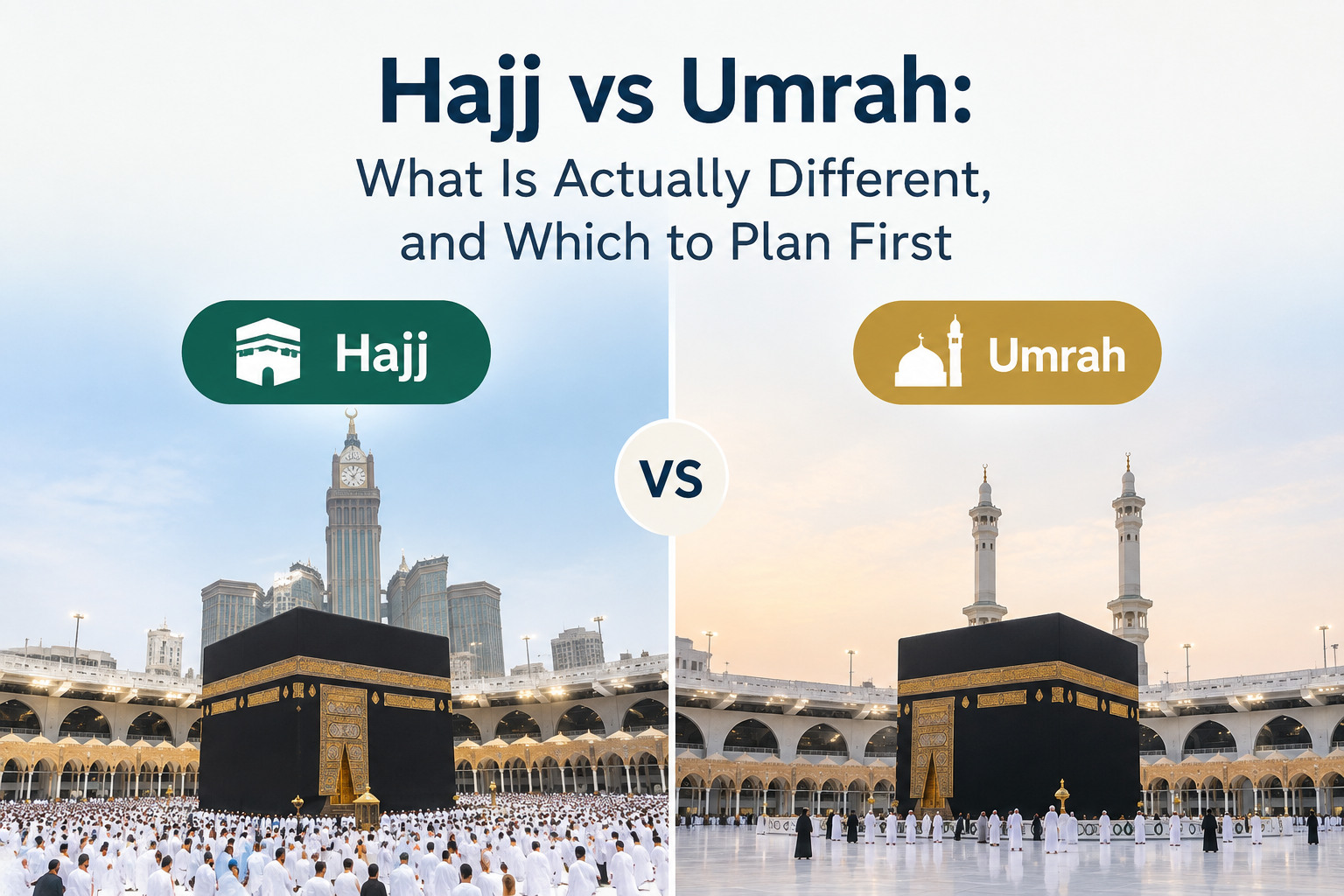
People often use Hajj and Umrah almost interchangeably in casual conversation, and then get caught off guard when the paperwork, cost, and timing turn out to be completely different. Both are forms of pilgrimage to Makkah, and both involve some of the same core rituals, but they are not two versions of the same trip. Understanding what actually separates them makes it much easier to plan realistically, especially if you are trying to decide which one to save for first.
What Umrah Actually Involves
Umrah is often described as the lesser pilgrimage, not because it matters less spiritually, but because it is shorter and not tied to a specific date on the Islamic calendar. It can generally be performed at almost any time of year, outside of the Hajj season itself. The core rituals are entering a state of Ihram, performing Tawaf by circling the Kaaba seven times, completing Sa’i by walking between the hills of Safa and Marwah seven times, and finishing with Halq or Taqsir, shaving or trimming the hair.
Because Umrah does not require the extended stay or the specific calendar window that Hajj does, it tends to be more affordable and considerably easier to fit around work leave, school holidays, or family schedules. It is also not something you can only do once. Many pilgrims perform Umrah multiple times over their life, and Saudi Arabia’s 2026 introduction of a one year, multiple entry Umrah visa was specifically designed to make repeat visits easier for exactly this reason.
What Hajj Adds on Top
Hajj includes everything in Umrah’s core rituals, then adds several more that only happen during a fixed window from the eighth to the thirteenth of Dhul Hijjah. These additional rites include standing in prayer at the plain of Arafah on the ninth day, considered the spiritual center of the entire pilgrimage, spending the night at Muzdalifah, staying at Mina for several days, and performing Ramy, the symbolic stoning of the Jamarat pillars. Many pilgrims also arrange for an animal sacrifice, known as Hadaya, depending on which of the three recognized categories of Hajj, Ifrad, Tamattu, or Qiran, they are performing.
Hajj is also one of the Five Pillars of Islam, obligatory once in a lifetime for any Muslim who is physically and financially able to undertake it, a concept generally referred to as Istita’ah. Umrah is highly recommended and spiritually significant, but it does not carry that same once in a lifetime obligation. If you have specific questions about your own religious obligation or which Hajj category applies to your situation, that is worth discussing directly with a knowledgeable scholar or imam, since it genuinely depends on personal circumstances rather than a single universal answer.
The Practical Differences That Actually Affect Planning
Cost and duration are where the two pilgrimages diverge the most in practical terms. Hajj packages typically run longer, often several weeks once travel, accommodation near the holy sites during the fixed dates, and the days at Mina and Arafah are all accounted for, and pricing reflects the intense seasonal demand on flights and accommodation during that single window. Umrah packages are usually shorter, commonly somewhere between one and two weeks, and pricing is generally steadier since demand is spread across most of the year instead of compressed into one fixed period.
Registration and visas follow genuinely different systems too. Hajj for Indian pilgrims runs through either the Haj Committee of India’s quota system or an approved private tour operator, both of which involve registration windows and selection processes that need to be started months ahead. Our post on how the Hajj quota and registration system works covers this in detail. Umrah has no comparable national quota, and as of 2026 pilgrims can even apply for a multiple entry visa valid for a full year, a flexibility that simply does not exist for Hajj. We cover the visa side of both in our complete Hajj and Umrah visa guide, and both processes ultimately run through Saudi Arabia’s official Nusuk platform.
Why Many First Time Pilgrims Choose Umrah First
There is no religious requirement to perform Umrah before Hajj, but a large number of first time pilgrims choose that order anyway, for practical reasons. Umrah gives you direct experience with the rituals, the crowds, the climate, and the physical demands of being in Makkah, at a fraction of the cost and planning lead time of Hajj. For many people, that experience makes the far larger commitment of Hajj, both financially and in terms of registration timelines through the Haj Committee of India, feel much less daunting when the time comes.
It is also worth being honest that saving for Hajj takes time for most families, and there is genuinely nothing wrong with performing one or more Umrahs during that saving period rather than waiting entirely idle. If this describes your situation, our Umrah packages are built with exactly this kind of repeat, budget conscious traveler in mind.
Planning Around Family Circumstances
The right choice between the two also depends heavily on who you are travelling with. Hajj’s longer duration, larger crowds, and physically demanding days at Mina and Arafah are a real consideration for elderly parents or very young children, and Saudi authorities have introduced age restrictions for Hajj in recent seasons specifically due to these physical demands. Umrah, by comparison, has historically been far more accessible across a wide age range, though it still requires real planning for anyone travelling with vulnerable family members. Our guide to planning Umrah with elderly parents or young kids goes into this in more depth if that applies to your trip.
Group dynamics matter too. If you are travelling as part of a mosque group or a larger family unit, our post on group Umrah bookings for mosques and community organizations is worth reading alongside this one, since coordinating a larger group changes some of the practical calculations around both pilgrimages.
A Few Common Misconceptions Worth Clearing Up
One misunderstanding comes up often enough to address directly: performing Umrah, even multiple times, does not fulfill the religious obligation of Hajj. They remain separate acts, and completing one does not substitute for the other, regardless of how many times you have made the shorter pilgrimage. If you are unsure how this applies to your own situation, that is again a question worth taking to a scholar rather than assuming based on general online advice.
Another common worry, particularly among first time pilgrims, is that you need to speak Arabic to perform either pilgrimage properly. In practice, most guides, group leaders, and even signage around the mosque areas cater to a wide range of languages, and pilgrims from India in particular travel in large enough numbers that Hindi, Urdu, and other regional languages are commonly heard and accommodated. You do not need fluency in Arabic to complete either pilgrimage meaningfully.
There is also a tendency to assume Umrah is automatically the easier option physically, simply because it is shorter. It still involves genuine walking distances during Tawaf and Sa’i, standing for long periods in significant heat, and navigating large crowds, so it is not something to treat as a light or casual trip. Reasonable physical preparation matters for Umrah too, even if the overall demands are lower than Hajj’s.
Making the Decision
If cost, timing flexibility, and a lower commitment level matter most right now, Umrah is the more realistic near term option for most people, and it does not close the door on Hajj later. If you have already met the religious and financial conditions for Hajj and are ready for the larger commitment, it makes sense to begin the Haj Committee of India or private operator registration process as early as your current season allows, since the timelines genuinely do not leave room for last minute decisions. Whichever direction you are leaning, our guide to choosing a one stop travel agency covers what to look for so flights, visas, and accommodation are coordinated properly rather than pieced together separately.
Frequently Asked Questions
Is Umrah a smaller or less important version of Hajj?
Not exactly. Umrah is shorter and not obligatory the way Hajj is, but it carries real spiritual significance in its own right and is not simply a scaled down substitute. The two serve different purposes within Islamic practice.
Can I perform Umrah and Hajj on the same trip?
Only if your visa and registration are specifically arranged for Hajj, since a standard Umrah visa, including the newer multiple entry version, is not valid for entry during the Hajj season. Combining both requires planning around the correct Hajj visa route from the start.
Do I need to perform Umrah before I am allowed to do Hajj?
No, there is no requirement to perform Umrah first. Many pilgrims choose to do so anyway for practical reasons, such as building familiarity with the rituals and easing into the larger financial and logistical commitment that Hajj involves.
Which pilgrimage is more suitable for elderly family members?
Umrah is generally considered more accessible for elderly pilgrims due to its shorter duration and the absence of some of Hajj’s more physically demanding rites, though both still require careful planning. Our guide on planning Umrah with elderly parents or young kids has more detail.
Not Sure Which One Fits Your Situation?
At RTW Travel & Tours, we help pilgrims from Bangalore plan both Hajj and Umrah, and a good part of that conversation is simply figuring out which one actually fits your budget, timeline, and family situation right now. If you are still weighing the decision, reach out to our team and we will walk you through what each option realistically looks like for you, from our Hajj packages to our Umrah packages.